dailypioneer.com ·
A Delicate Balance 12 Years of Government Judiciary Relations Under Nda
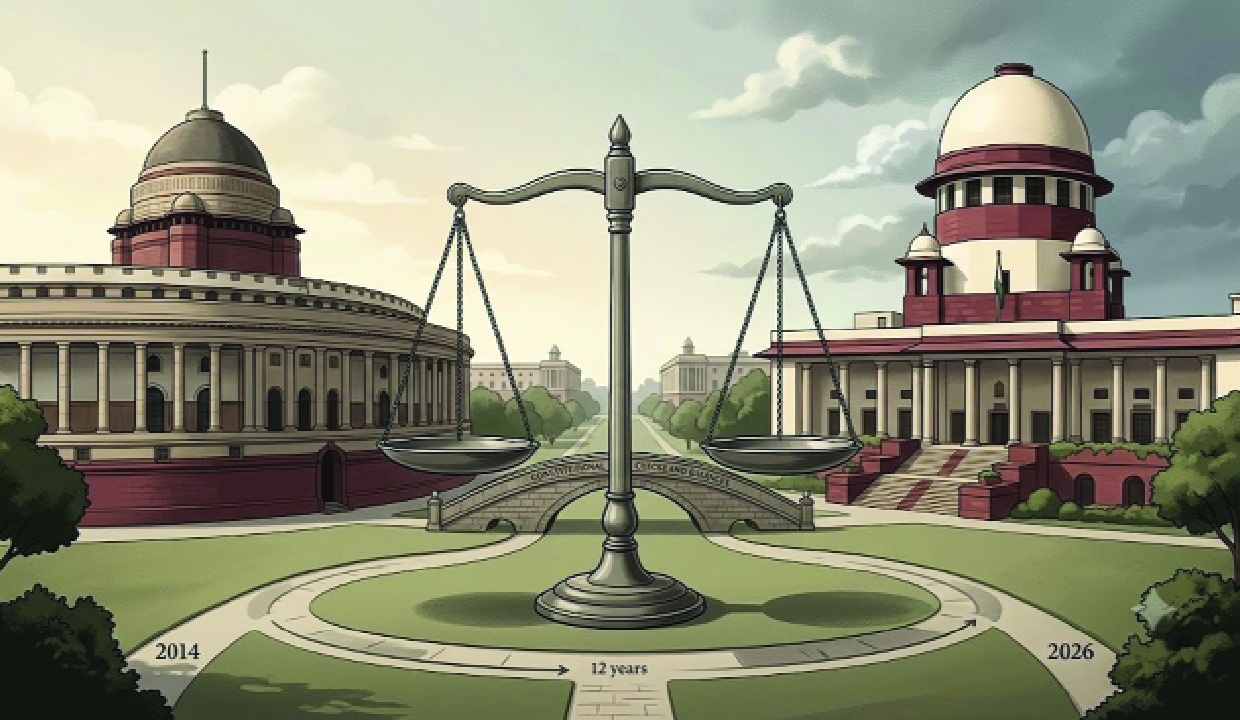
News Analysis — AI Analysis
Original analysis generated by News Analysis. This is our own commentary on the story, not the publisher's article text.
The article reviews the 12-year relationship between the NDA government and the Indian judiciary, characterizing it as a mix of cooperation and deep tension. While both institutions have successfully collaborated on modernizing court technology, their fundamental disagreement over judicial appointments remains a major source of conflict. The executive's use of special laws and administrative delays, alongside the judiciary's interventions in political funding and arbitrary demolitions, highlight this delicate balance of power.
Key points
- Cooperation has been most visible in modernizing court administration through joint efforts like digitizing courts and establishing virtual hearings.
- The primary source of tension is the dispute over judicial appointments, stemming from the Supreme Court's rejection of the government's NJAC proposal.
- The executive frequently uses administrative delays and selective clearing to express displeasure regarding judicial independence.
- The judiciary has intervened in major political issues, notably by striking down the Electoral Bonds scheme and regulating 'bulldozer justice'.
- Disputes over environmental clearances and special laws (like PMLA/UAPA) demonstrate ongoing friction between economic mandates and constitutional checks.
Claims assessed
- VerifiableThe government and judiciary have cooperated on technology, digitizing courts and establishing virtual hearings, making the legal system more transparent.
- VerifiableThe Supreme Court struck down the National Judicial Appointments Commission (NJAC) in 2015, asserting that judicial independence requires minimal executive interference.
- VerifiableThe judiciary has repeatedly warned that indefinite detention without trial constitutes punishment and is a check against aggressive executive enforcement.
- VerifiableThe Supreme Court cancelled the government's preferred political funding system (Electoral Bonds) in 2024, deeming anonymous corporate donations unconstitutional.
- VerifiableThe judiciary has issued guidelines preventing arbitrary demolitions ('bulldozer justice'), asserting that the executive cannot act as a judge.
Missing context
The article does not provide specific details on the current legal status of the NJAC or any proposed alternative mechanism for judicial appointments that might resolve the core conflict.
Topic context
Related topics
The full article is on the original publisher site.
AI insight
AI-generatedThe article discusses the historical and political relationship between government bodies (National Democratic Alliance) and the judiciary (Supreme Court, National Judicial Data Grid). It focuses on institutional governance and legal history rather than any direct commercial mechanism affecting prices, supply chains, or corporate margins. No concrete commercial impact is detectable.
Signals our AI researcher identified
Extracted by our AI model from this article and related public sources — not direct quotes from the publisher.
- (not specified)
Affected products & commodities
- (not specified)
Supply-chain signals
- (not specified)
Related stories

kmbc.com
Kevin Warsh First Fed Meeting Interest Rates

kuow.org:443
3 things to know about the new fed chief s first meeting

bobsguide.com
What Zilchs Fjord Bank Acquisition and Dame Clare Barclays Appointment Signal for Cross Border Fintech Scaling

aa.com.tr
Opinion Investing in Spacex a Path Toward a Planetary Panopticon

yahoo.com