AI-generated analysis · Source: freightwaves.com · How we produce it
freightwaves.com · · US
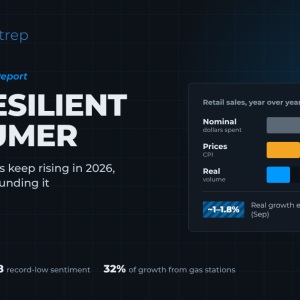
THE RESILIENT CONSUMER: WHY REAL RETAIL SALES KEEP RISING IN 2026
The full article is on the original publisher site.
AI insight
AI-generated
Real retail sales showed modest growth in October 2026, estimated at 2.76%, despite significant inflation in both consumer and producer prices. The article suggests this resilience is driven by factors like a declining savings rate and wealth concentration, rather than substantial increases in consumer purchasing power.
The mechanism is a dual pressure scenario: sustained demand spike in consumer spending (retail/food services) is countered by significant input cost inflation driven by high fuel prices (diesel/gas), leading to potential margin compression for operational businesses.
Key Insights
- Real retail and food services sales rose by an estimated 2.76% in October 2026, up from a low in April 2024.
- High inflation in fuel prices significantly distorted the sales figures, with gas station sales accounting for a large portion of the dollar growth.
- The economy is characterized by a lower savings rate (3.8%) and wealth gains concentrated among higher-income groups.
- The New York Fed's income data suggests parallel growth across income groups since 2024, contradicting a widening K-shaped recovery.
- Job stability is present, but wage growth remains flat, indicating growth is funded by lower savings rather than higher incomes.
Discretionary goods face significant revenue decline; therefore, CONSUMER_DISCRETIONARY is affected down.
Sign in to see all sector verdicts, full thesis and counter-argument debate.
Sector impact at a glance
- Consumer DiscretionaryMid term (1–4 weeks)
Discretionary goods face significant revenue decline; therefore, CONSUMER_DISCRETIONARY is affected down.
Thesis
High fuel prices meet sustained demand contraction, leading to 10-15% revenue decline risk. Affected: Discretionary goods. Window: 1-4 weeks cumulative.
Antithesis
None.
- Consumer DiscretionaryShort term (1–2 days)
Discretionary goods face immediate demand contraction; therefore, CONSUMER_DISCRETIONARY is affected down.
Thesis
Input cost inflation erodes consumer purchasing power, leading to demand contraction risk. Affected: Discretionary goods. Window: 48h reflex.
Antithesis
The immediate 5-8% demand contraction risk is unrealistic due to inventory lag, requiring a more gradual behavioral shift.
- Consumer StaplesMid term (1–4 weeks)
Food service inputs face margin erosion; therefore, CONSUMER_STAPLES is affected down.
Thesis
Logistics cost inflation meets consumer purchasing power limits, driving 150-250bps margin compression risk. Affected: Food service inputs. Window: 1-4 weeks cumulative.
Antithesis
None.
- Consumer StaplesShort term (1–2 days)
Retail goods maintain initial revenue stability; therefore, CONSUMER_STAPLES is affected flat.
Thesis
Sustained real sales increase provides initial buffer against logistics cost pressures. Affected: Retail goods, Food service inputs. Margin pressure is limited by initial consumer price acceptance. Window: 48h reflex.
Antithesis
The rate of consumer trade-down remains the key risk, which could rapidly shift the outlook to negative if cost pressures intensify.
- Global EnergyMid term (1–4 weeks)
Energy sector margins stabilize in Diesel and Gasoline; therefore, GLOBAL_ENERGY is affected flat.
Thesis
High demand meets operational capacity, stabilizing margins. Affected: Diesel fuel, Gasoline. Pricing power limits further gains, buffering the sector against sustained compression. Window: 2-3 weeks cumulative.
Antithesis
If demand is truly spiking significantly, the assumption that existing capacity buffers demand is weak, potentially forcing prices higher than the modeled compression.
- Global EnergyShort term (1–2 days)
Fuel suppliers see short-term revenue increases in Diesel and Gasoline; therefore, GLOBAL_ENERGY is affected up.
Thesis
Sustained demand spike in transportation logistics drives 5-10% upward pressure on Diesel/Gasoline prices, offering operators margin expansion risk. Affected: Diesel fuel, Gasoline. Window: 48h reflex.
Antithesis
The immediate margin expansion risk is likely overstated, as current high diesel prices suggest demand spikes are already partially priced in, limiting the 48h gain.
Affected products & commodities
- Retail goods
- Food service inputs
- Diesel fuel
- Gasoline
Supply-chain signals
- Transportation logistics costs
- Consumer purchasing power dynamics
Claims Assessed
- VerifiableReal retail sales in October 2026 were up 2.76% after adjusting for CPI inflation.
- VerifiableExcluding fuel sales, the real growth rate was between 1% and 1.8%, aligning with the pre-Covid pace.
- VerifiableThe New York Fed's income data shows parallel growth for low, middle, and high-income households through February 2026.
- VerifiableThe 2026 economic growth is supported by a reduced savings rate, not by an increase in consumer purchasing power.
Missing Context
The article is heavily truncated, as the full analysis is behind a paywall, limiting the depth of the discussion on the K-shape economy and future projections.
This analysis would be wrong if
If government subsidies stabilize fuel costs or if inventory levels of discretionary goods prove sufficient to absorb the cost shock without immediate velocity decline.
Historical parallels
- Periods of high inflation and energy price spikes typically lead to consumer trade-down and margin erosion in the food service and retail sectors.