wrp.org.uk · · GB
State of Emergency in Bolivia Armed Police and Fascists Attack Protests
News Analysis — AI Analysis
Original analysis generated by News Analysis. This is our own commentary on the story, not the publisher's article text.
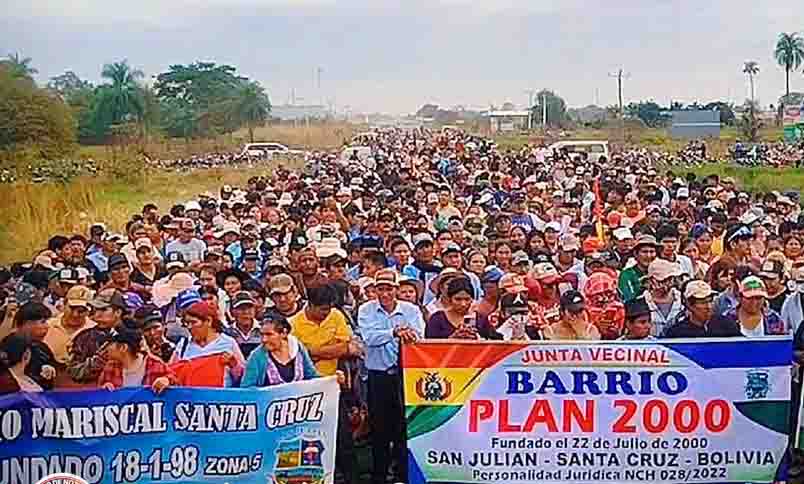
The article alleges that Bolivia is operating under a de facto State of Exception characterized by state terrorism. It reports on an attack on protestors in San Julián, Santa Cruz, where police and paramilitary groups, including the fascist Unión Juvenil Crucenista (UJC), allegedly used excessive force—including firearms, machetes, and grenades—against demonstrators who were blockading roads. The author criticizes President Rodrigo Paz's regime for its alleged corruption, disregard for the constitution, and continued support of these armed forces.
Key points
- The author claims Bolivia is experiencing a state of exception marked by terrorism and political instability.
- An attack occurred in San Julián on June 6th, where police and paramilitary groups allegedly attacked protestors with various weapons.
- The article accuses the regime of corruption, nepotism, and ignoring international recommendations to dismantle paramilitary forces.
- International bodies like the IACHR have warned that the current events resemble the incidents of the 2019 coup.
- Protestors successfully forced a retreat after five hours of resistance despite police deploying live ammunition.
Claims assessed
- UnverifiedBolivia is currently living under a de facto State of Exception and state terrorism.
- VerifiableThe paramilitary group Unión Juvenil Crucenista (UJC), led by officials, attacked protestors in San Julián with firearms, machetes, axes, grenades, and Molotov cocktails.
- VerifiableDuring the attack on protestors, one person died, more than 28 were injured, and dozens of arbitrary arrests were made.
- VerifiableThe Inter-American Commission on Human Rights (IACHR) warned that current events revive incidents similar to the 2019 coup.
Missing context
The article does not provide independent verification or sources for the specific claims of corruption, drug trafficking links to officials, or the exact number of casualties/arrests beyond citing a journalist's report. It also lacks context regarding the full scope of the 'aid' promised by the US.
Topic context
Related topics
The full article is on the original publisher site.
AI insight
AI-generatedThe unrest pushes construction inputs (cement/rebar) and general industrial costs 3-5% higher within days, driven by acute scarcity and logistics bottlenecks. Key risk: The magnitude of the cost inflation is moderated if alternative transport routes or international financial intervention stabilizes liquidity.
The unrest in Bolivia (EM_MARKETS) signals severe political instability and potential operational disruption. The widespread blockades directly impact logistics, supply chains, and general economic activity across multiple sectors (GLOBAL_INDUSTRIALS). This suggests a high risk of input cost inflation and reduced capacity utilization for goods movement.
Signals our AI researcher identified
Extracted by our AI model from this article and related public sources — not direct quotes from the publisher.
- State of emergency declared in Bolivia.
- Violent protests against President Rodrigo Paz's government.
- Over 100 blockades across the country, crippling the economy.
- Nearly 400 people detained.
- Protests led by Bolivian Workers Federation and indigenous organizations.
Affected products & commodities
- General consumer goods
- Construction materials
- Industrial inputs
Supply-chain signals
- Domestic transport routes (crippled by blockades)
- Local labor availability
Historical parallels
- Political unrest in Latin American countries often leads to temporary supply chain disruptions and currency volatility, impacting local EM_MARKETS.
This analysis would be wrong if
If key industrial facilities can operate under martial law with limited external movement AND major foreign investment injections are announced to stabilize commodity export revenues.
Blockades cause acute scarcity of construction inputs and labor, leading to immediate upward pressure on material costs. Cement and rebar prices rise within days.
Sign in to see all sector verdicts, full thesis and counter-argument debate.
Sector impact at a glance
- EM_CONSTRUCTIONmid
- EM_CONSTRUCTIONshort
- EM_MARKETSshort
- GLOBAL_INDUSTRIALSmid
- GLOBAL_INDUSTRIALSshort
Related stories

gazetadopovo.com.br
O Mapa Da Violencia Que O Brasil Ainda Nao Leu Perigo Do Discurso Com Solucoes Genericas

yahoo.com
Southern Baptists Weigh Immigration Resolution

philstar.com
Wedding Livestream Became Lead Jee Ick Joo Slay Mastermind
gazetadopovo.com.br
Caso Da Vacina Da Dengue Mostra Risco Da Censura a Questionamentos Sobre Imunizantes
organiser.org