economictimes.indiatimes.com ·
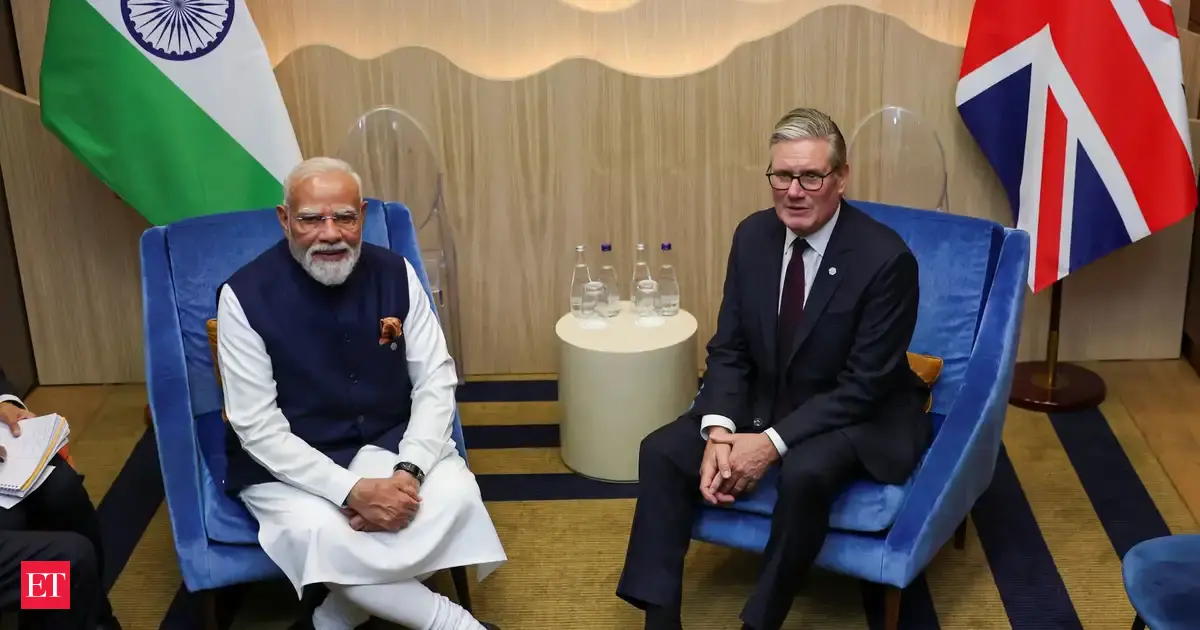
India UK Free Trade Deal to Take Effect on July 15 Opening 99 of Exports to Tariff Free Access
News Analysis — AI Analysis
Original analysis generated by News Analysis. This is our own commentary on the story, not the publisher's article text.
India and the UK are set to implement the Comprehensive Economic and Trade Agreement (CETA) on July 15, granting tariff-free access to 99% of India's exports. This deal significantly reduces tariffs across various sectors, including processed food, marine products, and textiles. Additionally, a Double Contribution Convention will take effect, benefiting over 75,000 Indian professionals.
Key points
- The CETA implementation on July 15 aims to boost bilateral trade by eliminating high tariffs (up to 70%) across multiple product categories.
- Beyond the trade deal, a Double Contribution Convention will be enacted, simplifying social security contributions for temporary workers in both nations.
- India's exports are expected to benefit significantly from immediate duty-free access on nearly all tariff lines, leveling the playing field for key sectors.
- The agreement required resolving outstanding issues, notably Britain's steel safeguard measures and the UK's carbon border adjustment mechanism.
Claims assessed
- VerifiableThe India-UK free trade deal will grant tariff-free access to 99% of India's exports.
- VerifiableTariffs on processed food, marine products, and textiles will be reduced to zero under the new pact.
- VerifiableThe Double Contribution Convention will ensure temporary workers do not pay social security contributions in both India and the UK.
- VerifiableIndia's exports to Britain declined by 7.6% in FY26 compared to FY25, while imports rose by 36.1%.
Missing context
The article does not detail the specific economic impact or timeline for the reduction of tariffs on goods like Scotch whisky (halved to 75% immediately, then 40% by 2035) or the gradual reduction of import duties on automobiles over five years.
Topic context
The full article is on the original publisher site.
AI insight
AI-generatedThe India-UK CETA pushes Indian textiles and processed foods to see modest revenue uplifts (2/3) within 48 hours, driving short-term export optimism. Main risk: The realized commercial benefit is highly dependent on confirmed order volumes and logistical execution, rather than the mere announcement of tariff removal.
The bilateral trade agreement (CETA) significantly reduces input costs for Indian exporters entering the UK market by eliminating tariffs on 99% of goods. This boosts revenue potential and pricing power for Indian producers in textiles, processed food, and other manufactured goods, leading to increased export volumes from India.
Signals our AI researcher identified
Extracted by our AI model from this article and related public sources — not direct quotes from the publisher.
- India-UK Comprehensive Economic and Trade Agreement (CETA) takes effect on July 15, 2024.
- 99% of India's exports will gain tariff-free access to the UK.
- Tariffs on processed food and textiles will be reduced to zero.
- Scotch whisky tariffs will be halved.
Affected products & commodities
- Indian textiles
- Processed food (India origin)
- ], <0xC2><0xA0>
Supply-chain signals
- Reduced tariff barriers for Indian exports into the UK market.
Historical parallels
- Previous trade agreements (e.g., India-EU) typically lead to a sustained increase in export volumes and investment flows, improving profitability margins for affected domestic industries.
This analysis would be wrong if
If global capital flows or major commodity price movements overwhelm the localized trade benefits, causing INR to move against the positive structural trend.
Indian processed food exporters are expected to see sustained revenue growth and improved pricing power over the next few weeks. The key risk is that shifts in UK consumer preferences could counteract the trade benefits.
Sign in to see all sector verdicts, full thesis and counter-argument debate.
Sector impact at a glance
- EM_FOODmid
- EM_FOODshort
- EM_TEXTILEmid
- EM_TEXTILEshort
Related stories

miragenews.com
Indias Youth Led Cockroach Party Tough to
links.org.au
Jammu Kashmir Under Siege Unfinished Revolt Against National Oppression and Class Exploitation

punchng.com
Ekiti Decides Security Forces Mobilise as Inec Moves Sensitive Materials Today

statesboroherald.com
Capt Jared Akins Named Statesboros Interim Police Chief Effective July 1 2
alaskasnewssource.com