economictimes.indiatimes.com ·
Explained Why Japans Nikkei Soared to Lifetime High Even After Boj Hiked Interest Rates to 31 Year High
News Analysis — AI Analysis
Original analysis generated by News Analysis. This is our own commentary on the story, not the publisher's article text.
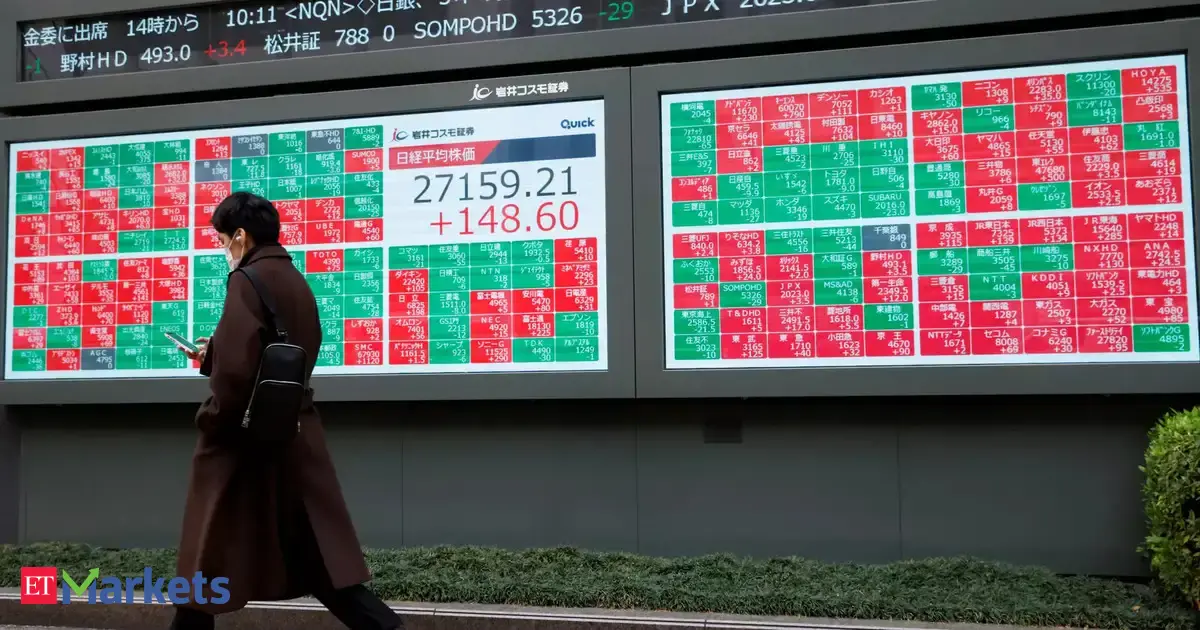
Despite the Bank of Japan (BOJ) raising its short-term policy rate to a 31-year high, Japan's Nikkei index surged past 70,000 for the first time. This strong market reaction suggests that investors viewed the BOJ's tightening measures as less threatening than anticipated, while positive sentiment was also boosted by news of an agreement between the US and Iran.
Key points
- The Nikkei 225 index reached a record high above 70,000 even after the Bank of Japan increased its interest rates to 1%.
- The BOJ's rate hike was expected by markets, marking the first increase since December and bringing borrowing costs to levels not seen since 1995.
- Market analysts suggested that the BOJ's tightening pace was gradual enough not to threaten liquidity or corporate earnings.
- Positive investor sentiment was also fueled by reports of a finalized peace deal between the US and Iran, which is expected to reopen vital oil shipping routes.
- Sector performance showed outperformance in chip-testing machinery makers and data center plays.
Claims assessed
- VerifiableThe Bank of Japan raised its short-term policy rate from 0.75% to 1%, bringing borrowing costs to levels not seen since 1995.
- VerifiableNikkei 225 jumped immediately after the announcement, hitting a fresh lifetime high above 70,000.
- VerifiableThe US-Iran peace deal was finalized by President Donald Trump, leading to the reopening of the Strait of Hormuz and ending blockades.
Missing context
While the article mentions that US markets were also active (S&P 500 gainers/losers), it does not provide a comprehensive analysis of how global economic conditions, beyond the specific BOJ hike and US-Iran deal, might impact Japan's economy in the long term.
Topic context
Related topics
The full article is on the original publisher site.
AI insight
AI-generatedThe BOJ's rate hike provides short-term support for the JPY (USD/JPY falls) and boosts Japanese tech equities. Global tech components also see a temporary uplift due to geopolitical de-risking, but sustained margin expansion is challenged by global competition. Main risk: If market skepticism limits the magnitude of policy reactions or if global competitors increase capacity, the positive momentum will rapidly unwind.
The primary commercial mechanism is a positive market sentiment driving capital inflows into Japanese equities, despite the BOJ's rate hike. The immediate impact is sector-specific (chip/data centers) rather than macroeconomic. The US-Iran peace deal acts as an external risk reduction factor boosting investor confidence in Japan. This suggests potential margin expansion for technology components within Japan.
Signals our AI researcher identified
Extracted by our AI model from this article and related public sources — not direct quotes from the publisher.
- Nikkei 225 index surged above 70,000 (record high)
- Bank of Japan (BOJ) raised interest rates to 1% (31-year high)
- Nikkei rose by 1% following the announcement
- Gains noted in chip-testing and data center sectors
Affected products & commodities
- Japanese equities
- Chip testing services
- Data center infrastructure
Supply-chain signals
- Japan's semiconductor/chip-testing capacity utilization
Historical parallels
- Historically, market indices can decouple from central bank policy announcements when positive external factors (like geopolitical risk reduction or strong corporate earnings) dominate investor sentiment. Price reaction is typically directional (upward) but magnitude depends on the relative strength of the catalyst vs. the rate hike impact.
This analysis would be wrong if
If Japanese equities fail to sustain investor confidence beyond the initial 48-hour reflex period, or if major hyperscalers announce CapEx cuts due to broader macroeconomic uncertainty.
Mid-term margin expansion for Japanese chip and data center infrastructure is unlikely. The outlook stabilizes due to competitive pressure from global rivals and existing supply chain buffers.
Sign in to see all sector verdicts, full thesis and counter-argument debate.
Sector impact at a glance
- EM_TECHmid
- EM_TECHshort
- FX_USDshort
- GLOBAL_TECHshort
Related stories

zerohedge.com
Europe Set Quiet Open Jpy and Aud Unreactive Expected Policy Meetings Uchida Ahead
abcnews.com
Fed Set Make Interest Rate Decision Inflation Hits

redpepper.co.ug
Death Trap Abroad Ugandan Workers Dying at Alarming Rate 40 Killed in Five Months

scientificamerican.com
Inside U S Labs at a Moment of Fear and Unexpected Promise

fortune.com