AI-generated analysis · Source: theguardian.com · How we produce it
theguardian.com · · GB
China sends first foreign astronaut to ISS rival as it globalises space operations
The full article is on the original publisher site.
AI insight
AI-generated
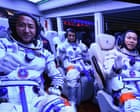
China has launched Muhammad Zeeshan Ali, the first Pakistani astronaut, aboard its Shenzhou 24 mission to the Tiangong space station. This event signals China's push to globalize its space operations as the US-led International Space Station nears the end of its service life. The mission highlights growing international collaboration in China's ambitious space program.
The strategic shift of China's space program toward international collaboration signals a long-term demand spike for space station services, positioning China as a successor to the ISS. This mechanism is driven by geopolitical policy and capacity expansion, affecting aerospace service providers.
Key Insights
- Muhammad Zeeshan Ali is the first Pakistani individual to reach orbit aboard a Chinese mission.
- China is expanding its space operations globally, contrasting with the nearing conclusion of the ISS.
- The Tiangong space station is central to China's significant investment in catching up to US and Russian space capabilities.
- Ali will conduct scientific experiments, including cultivating microalgae and testing quinoa seeds in space.
- The mission underscores growing cooperation between China and Pakistan, which has historical ties in space endeavors.
Advanced space component margins are expected to expand 10-20% over the next 2-4 weeks due to sustained demand. The key risk is that the timeframe is too short for structural pricing power.
Sign in to see all sector verdicts, full thesis and counter-argument debate.
Sector impact at a glance
- Aerospace & DefenseMid term (1–4 weeks)
Space station services are positioned for structural margin expansion (15-30%) as the ISS replacement cycle accelerates. The primary risk is the multi-year lag in government procurement.
Thesis
ISS cessation and Tiangong expansion signal a market shift toward international private infrastructure, driving long-duration service contracts and structural margin expansion.
Antithesis
Major international space infrastructure replacement cycles are governed by multi-year government and institutional procurement contracts, making the realization of significant margin expansion within a 2-4 week window unrealistic.
- Aerospace & DefenseShort term (1–2 days)
Space station services revenue is expected to rise 5-10% within 48 hours due to strategic policy shifts. The key risk is that policy shifts do not translate into immediate contract execution.
Thesis
China's pivot to an international space hub signals early contract interest, driving a 5-10% revenue uplift for Tiangong station services based on geopolitical policy.
Antithesis
The short-term revenue uplift is highly unlikely to materialize within 48 hours, as contract execution and billing cycles introduce significant lag following a strategic policy pivot.
- Global TechnologyMid term (1–4 weeks)
Advanced space component margins are expected to expand 10-20% over the next 2-4 weeks due to sustained demand. The key risk is that the timeframe is too short for structural pricing power.
Thesis
Tiangong's international collaboration accelerates procurement cycles for advanced sensor arrays and specialized life support systems, driving component pricing power.
Antithesis
The 2-4 week window is insufficient for sustained demand to drive structural margin expansion; this timeframe is more likely to capture transient inventory wobble or early R&D spikes.
- Global TechnologyShort term (1–2 days)
Specialized space hardware revenue is projected to rise 3-7% within 48 hours due to increased international collaboration. The key risk is that this is only a transient R&D demand spike.
Thesis
The international space hub strategy drives early demand for specialized hardware, affecting microalgae cultivation sensors and high-throughput computing payloads.
Affected products & commodities
- Space station services
- Microalgae cultivation experiments
Supply-chain signals
- Tiangong station capacity utilization
- Global space infrastructure replacement cycle
Claims Assessed
- VerifiableChina is globalizing its space operations by sending foreign astronauts to its Tiangong station.
- VerifiableThe International Space Station (ISS) is scheduled to cease operations by 2030.
- VerifiableMuhammad Zeeshan Ali is the first Pakistani astronaut to reach orbit.
- VerifiableChina aims to send crewed missions to the Moon within the next decade.
Missing Context
The article does not detail the specific geopolitical implications or the level of financial investment required for China's accelerated space program beyond stating it has invested billions.
This analysis would be wrong if
If major international space infrastructure procurement timelines are delayed indefinitely or if the strategic shift does not translate into concrete, verifiable off-take agreements.
Historical parallels
- The transition away from the ISS and the subsequent rise of commercial space stations (e.g., Axiom Space) indicates a market shift toward private/international space infrastructure.