economictimes.indiatimes.com ·
300 billion sanctions relief hormuz reopening who gets what in the us iran peace deal
News Analysis — AI Analysis
Original analysis generated by News Analysis. This is our own commentary on the story, not the publisher's article text.
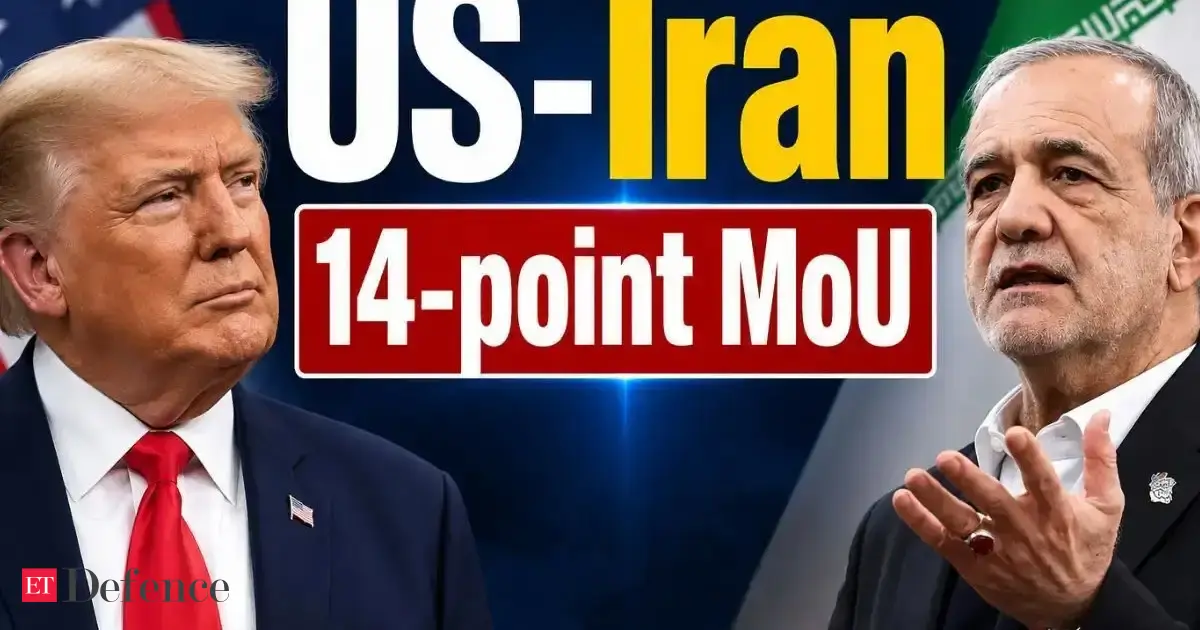
The US and Iran signed a 14-point Memorandum of Understanding (MoU) aimed at reducing military tensions and restarting economic cooperation. This preliminary agreement outlines plans for sanctions relief, reopening the Strait of Hormuz, releasing frozen Iranian assets, and launching negotiations regarding Iran's nuclear program. However, the deal is not final, requiring both sides to negotiate a comprehensive plan within 60 days.
Key points
- The MoU covers several areas, including sanctions relief, reopening the Strait of Hormuz, and releasing frozen Iranian assets.
- A key component is a commitment from the US to terminate all types of sanctions against Iran, including those linked to the UN Security Council and IAEA.
- The agreement proposes developing a joint reconstruction and economic development plan valued at at least $300 billion for Iran.
- US commitments include removing its naval blockade and ending activities that interfere with Iranian maritime operations.
- Both parties have 60 days to negotiate the final, comprehensive deal, focusing on sequencing and implementation.
Claims assessed
- VerifiableThe US and Iran signed a preliminary MoU outlining plans for sanctions relief, reopening the Strait of Hormuz, and releasing frozen assets.
- VerifiableThe agreement requires both countries to negotiate a final, comprehensive deal within 60 days.
- VerifiableThe US commits to terminating all sanctions against Iran, including those from the UN Security Council and IAEA, in an agreed-upon schedule.
- VerifiableA joint reconstruction plan of at least $300 billion is proposed for Iran's economic development.
Missing context
The article does not specify which US official signed the MoU or provide details on the current political climate in Iran beyond mentioning the Iranian President. It also lacks specifics on the 'regional partners' who will contribute to the $300 billion reconstruction plan.
Topic context
Related topics
The full article is on the original publisher site.
AI insight
AI-generatedGeopolitical de-escalation pushes Crude Oil spot prices 2-4% higher within 7 days, while mid-term capital investment surges across regional energy infrastructure. Main risk: The immediate price spike is likely to be capped by existing inventory buffers and OPEC+ quota management.
The MoU signals a potential de-escalation in geopolitical risk, directly impacting global energy supply and trade routes. Reopening the Strait of Hormuz removes a major choke point constraint on oil/gas transit (supply_shortage), potentially easing input costs for global energy consumers and boosting investment sentiment across related sectors. The focus is on reducing sanctions barriers and facilitating reconstruction financing.
Signals our AI researcher identified
Extracted by our AI model from this article and related public sources — not direct quotes from the publisher.
- $300 billion investment and reconstruction plan
- Sanctions relief planned
- Reopening of the Strait of Hormuz
- Removal of US naval blockade
- 60 days to negotiate comprehensive deal
Affected products & commodities
- Crude Oil
- Natural Gas
- Global Trade Financing
Supply-chain signals
- Strait of Hormuz transit capacity
- US-Iran trade sanctions regime
- Iranian energy export routes
Historical parallels
- Past de-escalation agreements in the Middle East generally lead to short-term volatility followed by stabilization and increased capital flow into regional infrastructure/energy projects.
This analysis would be wrong if
If EIA inventories prove sufficient or if the de-escalation agreement fails to include verifiable commitments on increased non-OPEC supply.
Mid-term capital investment is expected to surge across regional energy infrastructure and reconstruction projects. This supports margin expansion for EPC and service providers over the next 2-4 weeks.
Sign in to see all sector verdicts, full thesis and counter-argument debate.
Sector impact at a glance
- COMMODITY_OILmid
- COMMODITY_OILshort
- EM_INDUSTRIALSmid
- FX_USDmid
- GLOBAL_ENERGYmid
- GLOBAL_ENERGYshort
Related stories

countercurrents.org
Irans War a Pyrrhic Victory

countercurrents.org
The Thermodynamics of Capital Artificial Intelligence Energy Crisis and Ecological Crisis
finanzen.ch
Shell and St Pauls Hospital Drive Low Carbon Development in Hong Kongs Healthcare Sector

thenewdawnliberia.com
The Boakai Administration Borrowed Us496 53 Million in Just 24 Months What Does It Mean for Liberias Future

arkansasonline.com