www.businesstoday.in · · IN
Anger Spills Onto Delhi Streets Why Are Auto Drivers Tearing Down Trump Posters 536763 2026 06 14
News Analysis — AI Analysis
Original analysis generated by News Analysis. This is our own commentary on the story, not the publisher's article text.
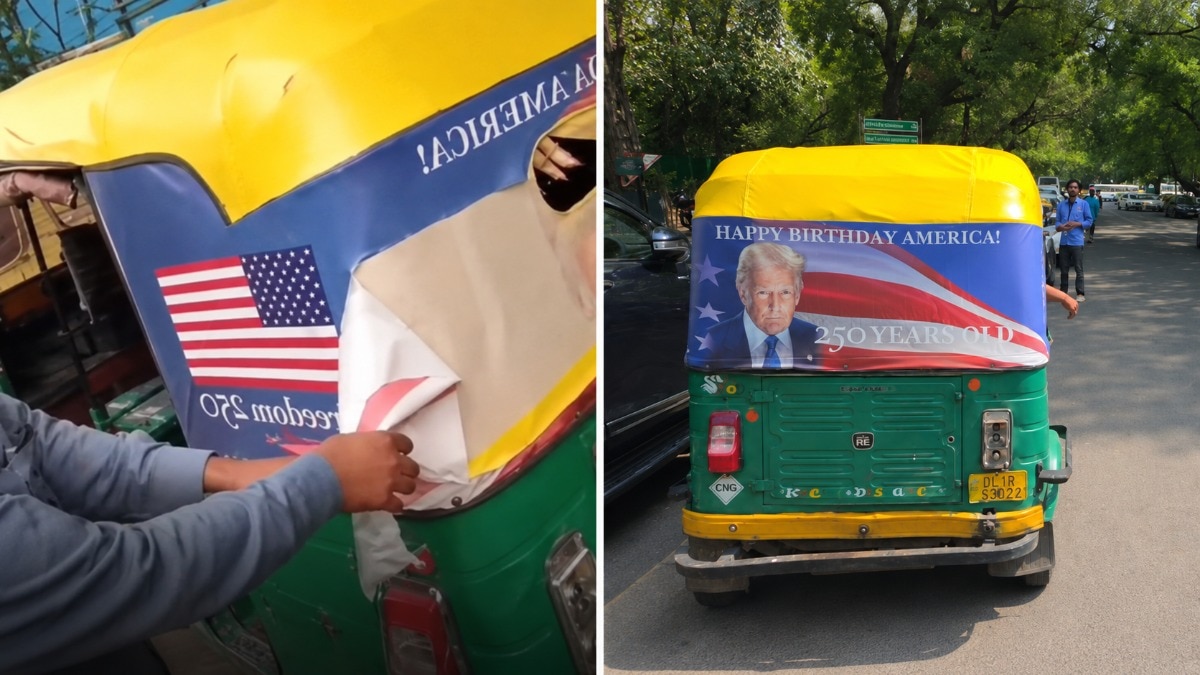
Following the deaths of three Indian sailors in a US attack on a tanker in the Gulf of Oman, auto-rickshaw drivers in Delhi began tearing down posters for the US Embassy's 'Freedom 250' campaign. The incident highlights growing public anger over the US military action against commercial shipping that involved Indian crew members. Disputes also arose regarding the details of the attack and subsequent diplomatic exchanges.
Key points
- Auto-rickshaw drivers in Delhi protested by tearing down 'Freedom 250' posters after a US strike killed three Indian sailors.
- The initial incident involved a Palau-flagged tanker, MT Settebello, struck in the Gulf of Oman, resulting in three fatalities among 24 Indian crew members.
- The vessel operator disputed the US Central Command's account of the attack, stating no warning or communication was established prior to the action.
- This incident followed two other attacks on tankers (MT Marivex and MT Jalveer) near Oman involving Indian sailors, though all crews were rescued in those cases.
- Indian officials protested the US Navy's actions, but a subsequent State Department readout indicated that US Secretary of State Marco Rubio stressed compliance with US forces.
Claims assessed
- VerifiableThe auto-rickshaw drivers tore down posters related to the 'Freedom 250' campaign following the death of three Indian sailors in a US military strike.
- VerifiableUS Central Command stated that its aircraft fired munitions into the tanker's engine room because the crew failed to follow instructions.
- VerifiableThe vessel operator, iOS Marine, disputed the US account, claiming no warning or communication was successfully established before the attack.
- VerifiableIndian officials raised concerns about the attacks during a call with US Secretary of State Marco Rubio.
Missing context
The article does not provide details on the current status of US-India diplomatic relations following these incidents, nor does it offer an independent investigation report to definitively settle the conflicting claims regarding the tanker attack.
Topic context
The full article is on the original publisher site.
AI insight
AI-generatedGeopolitical tensions will increase marine cargo insurance and freight costs in the Indian Ocean corridor short-term (2-48h); COMMODITY_SHIPPING and GLOBAL_INSURANCE rise, while FX_EM faces depreciation pressure. Main risk: The magnitude of rate spikes is likely moderated by existing commercial contracts and alternative trade routes.
The news describes a geopolitical protest in India following an incident involving the US Navy and an Indian crew member on a flagged tanker. This is primarily political/social unrest, not directly tied to commodity pricing or commercial supply chain disruption. However, heightened regional tensions (Gulf of Oman) increase risk premiums for shipping insurance and logistics operations passing through the region.
Signals our AI researcher identified
Extracted by our AI model from this article and related public sources — not direct quotes from the publisher.
- Incident date: June 14, 2026
- Location: Gulf of Oman
- Involved parties: US Navy, Indian sailors, Palau-flagged tanker MT Settebello
- Protest location: Delhi streets (India)
- Trigger event: US military strike killing three Indian sailors
Affected products & commodities
- Marine cargo insurance rates
- Shipping freight costs in the Middle East/Indian Ocean corridor
Supply-chain signals
- Gulf of Oman transit security
- Maritime insurance risk assessment (War Risk)
Historical parallels
- Geopolitical tensions in the Red Sea/Houthi attacks historically cause immediate spikes in global shipping freight rates and war-risk premiums for vessels traversing the area.
This analysis would be wrong if
If geopolitical tensions de-escalate rapidly or if major shipping carriers announce sufficient capacity buffers/alternative routing mechanisms that negate the need for immediate premium increases.
Sustained geopolitical risk will stabilize freight costs in the Indian Ocean corridor mid-term. Affected: Bulk commodity transport rates, Tanker charter rates. Key risk: Alternative routes (e.g., Cape of Good Hope) can mitigate sustained rate hikes.
Sign in to see all sector verdicts, full thesis and counter-argument debate.
Sector impact at a glance
- EM_TRANSPORTmid
- EM_TRANSPORTshort
- FX_EMshort
- GLOBAL_INSURANCEshort
Related stories
oneindia.com
Tear Gas Baton Charge at Patliputra Station as Bihar Police Exam Candidates Protest Travel Woes
oneindia.com
US Blockade Violations Will Not Be Tolerated Marco Rubio Defends Hormuz Operations After Jaishank
winnipegfreepress.com
Qatari Mediators Travel to Tehran for Final Touches on a Possible Deal to End War
yahoo.com
Ukraine Targets Russian Industrial Facilities
independent.co.uk