www.bankingnews.gr · · GR
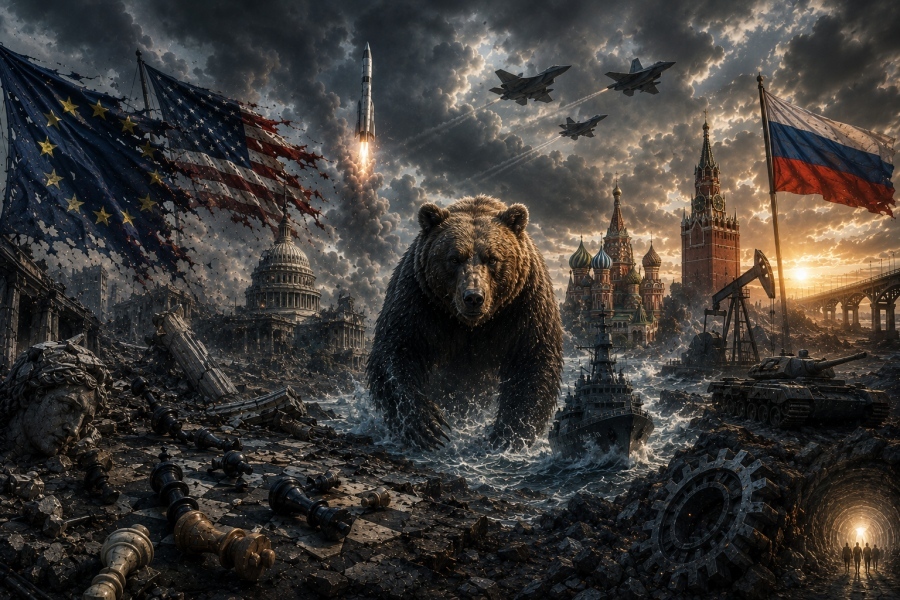
it even surpassed world war i russia s shock to the west what moscow s resilience reveals about the limits of sanctions title=
News Analysis — AI Analysis
Original analysis generated by News Analysis. This is our own commentary on the story, not the publisher's article text.
The article argues that the Russia-Ukraine conflict has become an unprecedentedly long military struggle, surpassing the duration of World War I. It challenges the Western assumption that comprehensive economic sanctions could force a major power to abandon its objectives, noting that despite extensive measures like freezing reserves and oil price caps, Russia's economy adapted and continued the war effort.
Key points
- The Russia-Ukraine conflict surpassed the duration of World War I on June 11, 2026, making it the longest continuous military conflict in Europe since WWII.
- Western powers initially believed that a combination of economic pressure could substitute for military action to force Russia out of the war.
- Sanctions implemented included freezing $300 billion in reserves, cutting off SWIFT access, imposing oil price caps, and restricting dual-use technologies.
- Despite these measures, Russia's economy showed resilience, with GDP rebounding after initial dips and maintaining military production capacity.
- The article suggests that sanctions imposed costs on Russia but failed to create enough coercion, especially given the willingness of non-Western nations to maintain trade links.
Claims assessed
- VerifiableThe belief in early 2022 was that economic pressure could force a nuclear-armed great power like Russia to abandon its objectives.
- VerifiableWestern sanctions included freezing $300 billion of Russian central bank reserves and restricting access to the SWIFT system.
- VerifiableRussia's GDP rebounded significantly in 2023 (3.6% growth) and increased by 4.3% in 2024, despite sanctions.
- VerifiableThe war continued despite the implementation of over 16,000 individual economic measures from more than thirty governments.
Missing context
The article does not provide detailed information on the specific non-Western nations or trade mechanisms that allowed Russia to bypass sanctions and maintain its economic stability.
The full article is on the original publisher site.
AI insight
AI-generatedRussia's ability to redirect oil exports provides a modest short-term boost to crude oil prices (2-3% up within 48 hours). However, the mid-term outlook is significantly constrained by global economic slowdown risks and structural market saturation. Main risk: If geopolitical premiums are overemphasized without confirmation of sustained non-Western demand or if a major recessionary signal emerges, the upward momentum will rapidly reverse.
The news highlights Russia's economic resilience and ability to maintain industrial production and fund military operations despite extensive Western sanctions (G7 price cap, frozen reserves). The key commercial mechanism is the successful redirection of commodity sales (oil) from traditional Western markets to Asian buyers, mitigating the impact of input cost controls and maintaining revenue streams for Russian exporters. This suggests sustained demand/pricing power in specific emerging-market oil export channels.
Signals our AI researcher identified
Extracted by our AI model from this article and related public sources — not direct quotes from the publisher.
- Russia-Ukraine war started February 24, 2022
- Russian economy reported 3.6% growth in 2023
- Russian economy projected 4.3% growth in 2024
- Russian military spending reached $190 billion in 2025
- Russia found new markets for oil exports, particularly in Asia
Affected products & commodities
- Russian crude oil
- Industrial inputs (general)
- Military hardware components
Supply-chain signals
- Redirection of Russian oil exports to Asian markets
- Effectiveness limits of Western sanctions on commodity trade
Historical parallels
- Previous major geopolitical conflicts (e.g., Iran/Russia tensions) have shown that sustained demand from non-sanctioning blocs (Asia, Middle East) can stabilize or boost commodity prices and export revenues for sanctioned producers.
This analysis would be wrong if
If oil prices fail to show any immediate positive correlation with news regarding Asian off-take agreements and logistical success, or if global economic data (e.g., China PMI) signals an unexpected sharp contraction.
The mid-term oil outlook is tempered by global economic risks. Sustained premiums are vulnerable to a significant global slowdown or increased OPEC+ output.
Sign in to see all sector verdicts, full thesis and counter-argument debate.
Sector impact at a glance
- COMMODITY_OILmid
- COMMODITY_OILshort
- EM_ENERGYmid
- EM_ENERGYshort
- GLOBAL_INDUSTRIALSmid
- GLOBAL_INDUSTRIALSshort
Related stories
bankingnews.gr
It Even Surpassed World War I Russia S Shock to the West What Moscow S Resilience Reveals About the Limits of Sanctions

finanznachrichten.de
68803103 veraxa biotech gmbh veraxa biotech establishes in vitro proof of concept for novel bitac adc technology platform and launches partnering discussions 399
finance.yahoo.com
Elon Scared Conversation Democrat Fires
proactiveinvestors.com
Ftse 100 Live Stocks and Pound Fall Bank of England Holds Rates
ibtimes.co.uk